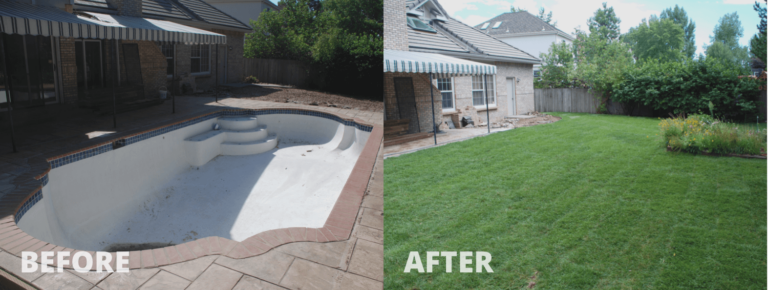
Can You Build on Filled-In Pool Ground? Contra Costa County Rules Explained
On This Page
- What Decides Whether You Can Build on Filled-In Pool Ground
- Contra Costa’s Two Backfill Permits: G and GN
- The Note That Goes on Your Parcel, and What It Costs You Later
- What You Can Put Over an Uncertified Fill Area, and What You Cannot
- How Slope and Clay Soil Change the Rules in the Contra Costa Hills
- Planning an ADU Over an Old Pool: What Order to Do It In
- Is engineered fill the same thing as a full pool removal?
- Can I build an ADU over a pool that was filled in ten years ago?
- How long does backfilled ground keep settling?
- Why does the ground over an old pool start sinking years later?
- What makes engineered backfill a bigger job than a basic fill-in?
- What should I ask a pool removal contractor if I might build there later?
- Talk to Bye Bye Pool Before You Pick a Fill Method
Direct Answer: In Contra Costa County, you can build on filled-in pool ground only if the pool was backfilled with engineered fill under a G-supervised grading permit and a licensed civil or geotechnical engineer signed a final compaction report.
You are looking at a pool you no longer want, and somewhere in the back of your mind sits a second thought: a rental unit, a bigger garage, a room for a parent moving in. So the real question is not how to get rid of the pool. It is whether the ground left behind can hold a foundation.
Vocabulary is where most homeowners get tripped up. “Pool fill-in,” “partial removal,” “abandonment,” and “full demolition” get used loosely by contractors, and they do not mean the same thing on a permit. Contra Costa County draws a hard line between two backfill methods, and the one you pick at demolition time decides whether you can build on filled-in pool ground for as long as you own the property.
This guide covers three things: the two permit tracks the County uses, the permanent restriction attached to the cheaper one, and the order of operations that keeps a future ADU on the table. Tell us what you are planning and we will walk you through which track fits your yard.
What Decides Whether You Can Build on Filled-In Pool Ground
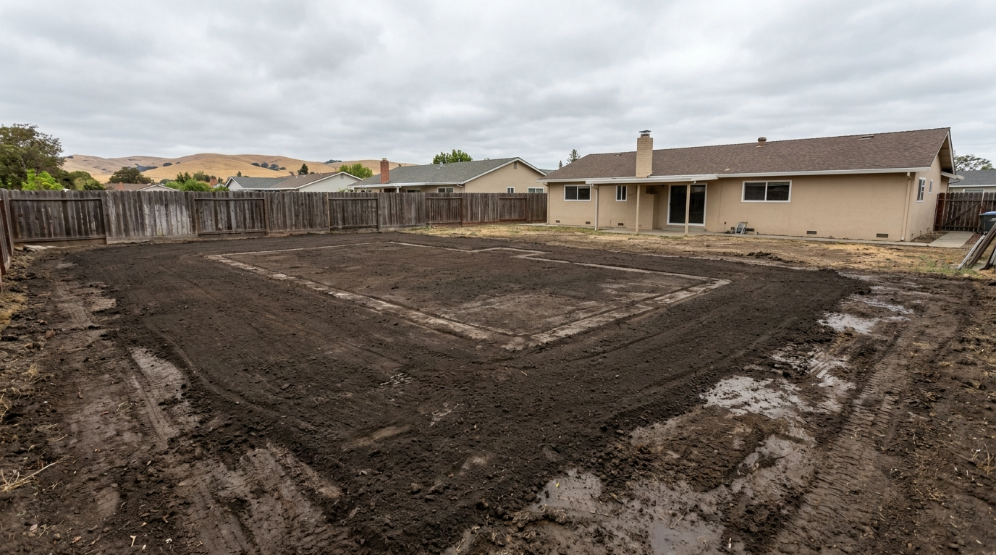
The permit pulled at demolition time decides it, not how the yard looks today. Two backyards can be identical on the surface, flat and grassed with no sign a pool was ever there, and only one will pass plan check for an ADU. The difference lives in County records.
People assume time solves this. Homeowners tell us the pool was filled in 2015, the lawn has never sunk, so surely it has settled. Settlement you can see is not documented bearing capacity. A plan checker reviewing your foundation drawings wants a compaction report with an engineer’s stamp on it, and elapsed time does not produce that document after the fact.
There is a second problem: nobody knows what went into the hole. If the shell stayed in place and the cavity took whatever was on site, the fill can hold broken concrete, chunks of coping, and pockets of soil that were never compacted in layers. That material can look stable for a decade and still compress unevenly the moment a footing puts real load on it. So the first move toward permission to build on filled-in pool ground is a records search, not a soil test.
Contra Costa’s Two Backfill Permits: G and GN
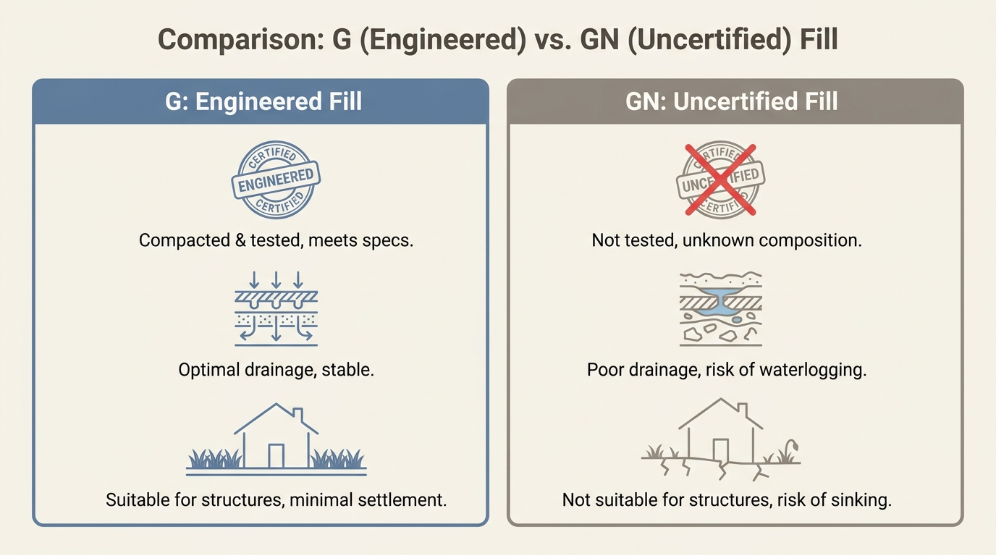
The County recognizes exactly two ways to backfill a residential pool and labels the permit accordingly. Applications are designated G-supervised for engineered fill capable of supporting a structure, or GN-unsupervised for uncertified fill that may not support anything. Both require a permit. Only one keeps your options open.
| Requirement | G: Engineered Fill | GN: Uncertified Fill |
|---|---|---|
| The shell | Removed from site, unless the soils engineer approves leaving it with part of the bottom broken for drainage | Stays in place, top 24 inches of bond beam removed unless above grade |
| Fill material | Approved fill compacted to at least 90 percent relative compaction per ASTM D1557, or as the soils engineer requires | Uncertified fill, dirt source declared on the application |
| Drainage | Bottom inspected and approved before any fill is placed | Three or more holes, minimum 24 inches across, no more than 8 feet apart |
| Engineering sign-off | Final compaction report from a licensed civil or geotechnical engineer, approved by the County | None |
| Note on the parcel | None | “Restricted Area on Site, due to abandoned swimming pool not Suitable for Building” |
| Future use | Can support footings once the report is approved | Landscaping only |
| Slope limit | None on this track | Not allowed on ground steeper than 10 percent |
Read the last two rows together and the choice gets clearer. The GN track moves faster and brings fewer trades on site. The G track takes longer and puts an engineer in your schedule, and it is the only one that lets you build on filled-in pool ground later.
One detail catches people mid-project. Site plans on the G track carry a note stating that the foundation for any new structure in the fill area cannot be poured until the final compaction report is approved and the County has inspected. Your ADU schedule bends around that approval, so put it on the calendar early.
The Note That Goes on Your Parcel, and What It Costs You Later
Almost nobody explains this before demolition day: choosing uncertified fill puts a permanent note on your property record. Contra Costa places a note on the parcel reading “Restricted Area on Site, due to abandoned swimming pool not Suitable for Building.” It does not expire when the fill settles, and it does not disappear when you sell.
The technical reason is simple. Nobody tested that fill, so nobody can certify what it carries. Without a compaction report, a plan checker has no basis to approve a footing over it and a structural engineer has nothing to design against. The note warns the next reviewer, and the next owner, that the area is off limits for structures.
The consequences land in three places:
- Plan check delays. An ADU submittal over a restricted area gets kicked back until you produce demolition documents, a geotechnical report, and a foundation design.
- Rework. Making that ground buildable means digging the fill back out, removing the shell, and redoing the job on the G track. You are paying to undo work you already paid for.
- Resale friction. Buyers who want an ADU read that note and factor it in. So do their lenders.
You can protect yourself without committing to the heavier track. Ask the County what your parcel already shows, then ask every contractor bidding the job one direct question: which designation are you pulling, G or GN, and will I receive a stamped compaction report at the end? Anyone who cannot answer that cleanly is not the crew for your backyard.
What You Can Put Over an Uncertified Fill Area, and What You Cannot
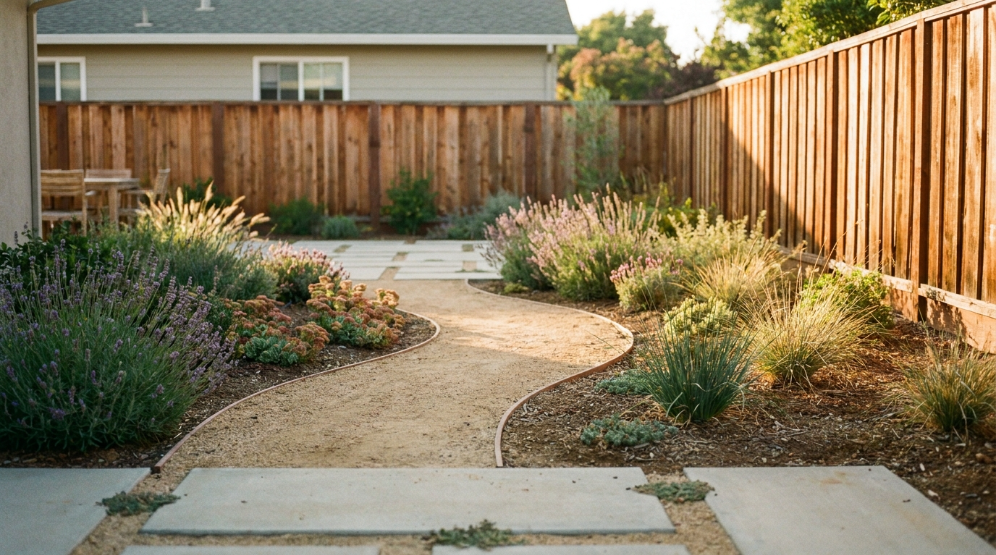
If your pool went in on the GN track, the area is restricted to landscaping purposes, and that word is doing real work. Here is how common backyard projects sort out.
- Lawn and planting beds. The intended use. Grass and shrubs put almost no concentrated load on fill. Common mistake: skipping a grading plan and ending up with a low spot that collects every winter storm.
- Loose-set patios and paths. Gravel, decomposed granite, and sand-set pavers flex with minor movement instead of cracking across it. Common mistake: pouring a monolithic slab, which telegraphs every void underneath.
- Freestanding light structures. A pergola or shade sail is often workable, but anything with a footing starts to look like a structure, so ask the County. Common mistake: assuming a shed counts as landscaping. It usually does not.
- ADUs, garages, additions. Not permitted over uncertified fill. Common mistake: designing the unit first and finding the restriction at plan check, after the drawings are paid for.
- Driveways and vehicle loads. These concentrate weight in a way lawn never does. Common mistake: parking a trailer on a filled pool area and learning how deep the voids run.
When is a straightforward fill-in still the right call? Often. If your lot already has an addition where you would want one, if the pool sits in a corner you only ever want as garden, or if you never expect to build on filled-in pool ground, the simpler track fits. Choose it knowing the trade, rather than discovering it three years later.
Not sure which category your yard falls into? Send us your address and a photo and we will tell you straight.
How Slope and Clay Soil Change the Rules in the Contra Costa Hills
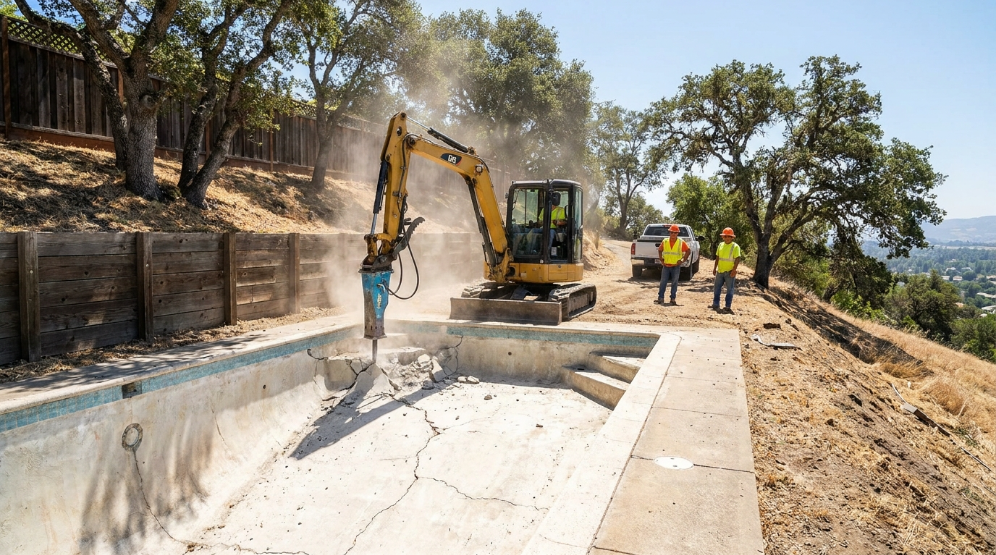
Slope can remove the choice entirely. The County does not allow the uncertified track when the pool sits on ground sloping steeper than 10 percent. On those lots, engineered fill is the requirement, not the upgrade.
That matters more here than in a flatter county. A pool cut into a terraced lot in Orinda, or dropped into the grade behind a house off Moraga Way, can pass that threshold without looking dramatic from the patio. Homeowners in Lafayette and the hills above Walnut Creek call us expecting the simpler option and learn the grade already decided.
Soil adds a second layer. Much of central Contra Costa, including the flatter streets around Concord and Pleasant Hill, sits on expansive clay that swells with water and shrinks as it dries. Clay is hard to compact well, which is exactly why the County wants testing on fill meant to carry a footing. Our crews typically find the worst voids under the spots that pond after the first heavy rain of the season.
Planning an ADU Over an Old Pool: What Order to Do It In
Do the pool work first, finish the compaction report, then submit the ADU. Reversing that order is the most common scheduling mistake we see, because an ADU submittal that lands on a former pool location will ask for demolition documents or a geotechnical report and foundation design before it moves.
A workable sequence looks like this:
- Check County records for existing pool and grading permits on the parcel.
- Bring in a soils engineer to inspect and specify before anything is filled.
- Pull the grading permit on the G track, with the fill source declared.
- Remove the shell, or break the bottom where the engineer specifies, and pass rough grade.
- Place and compact fill in layers, with the in-progress inspection around 48 inches from finish grade.
- Pass grading and drainage final, and get the compaction report approved.
- Submit the ADU plans with that report attached.
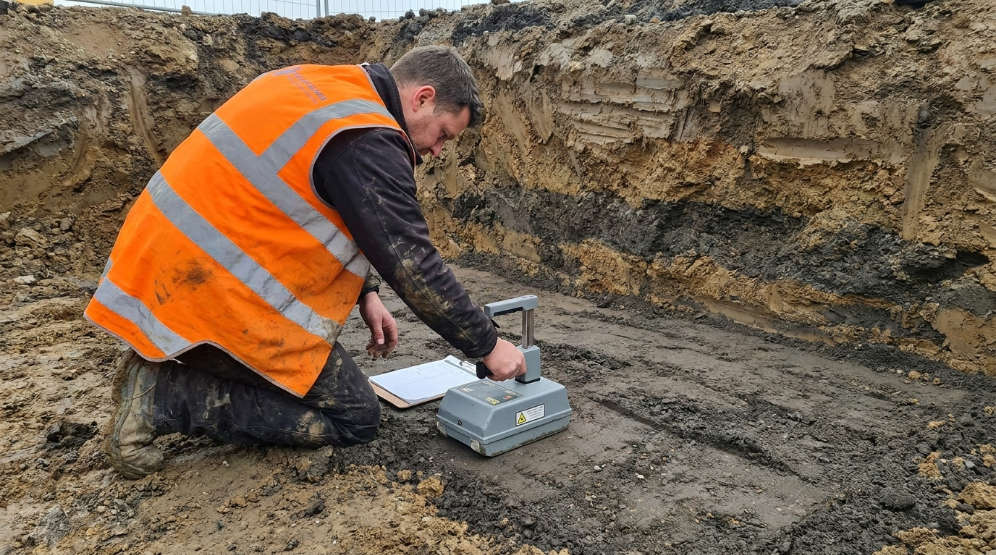
Contra Costa calls those inspections #601 Rough Grade, #608 In-progress, and #620 Grading and Drainage Final. The numbers are not trivia. They tell you where the project stalls if your engineer and the inspector are not scheduled in the same week.
Here is a composite scenario, drawn from the pattern rather than one named customer. A Walnut Creek homeowner plans a 700 square foot unit where an old diving pool sits. Going sequential, demolition and compaction add several weeks up front, and the ADU package goes in with a stamped report attached. Submitting the ADU first means the plan checker asks for documents that do not exist yet. Same scope, different calendar.
Homeowners who review us on Google and Yelp comment less about the excavator and more about the paperwork, which tracks with what this work really is. The digging takes days. The documentation determines whether you can build on filled-in pool ground at all. Our guide to pool removal across Contra Costa County breaks down how coverage and scheduling work city by city, and our about page explains how our crews approach demolition.
One thing to say plainly: nothing here replaces a site-specific evaluation. The compaction standards, slope thresholds, and inspection sequence above are County requirements, not an engineering opinion about your yard. Before you build over a former pool, have a licensed civil or geotechnical engineer look at the site and issue a report.
Frequently Asked Questions
Is engineered fill the same thing as a full pool removal?
Not exactly, though they overlap. Full removal takes the entire shell off site. Under the Contra Costa engineered fill track, the shell goes unless a soils engineer approves leaving it with part of the bottom broken for drainage. What defines engineered fill is the certified compaction, not the fate of the shell.
Can I build an ADU over a pool that was filled in ten years ago?
Only if that fill was placed and certified as engineered fill at the time. Ten years of settling does not convert uncertified fill into buildable ground, because approval rests on a compaction report that either exists or does not. If the parcel carries a restriction note, the area stays landscaping until the fill is excavated and redone under a supervised permit.
How long does backfilled ground keep settling?
It depends on how the fill was placed, not how long it has been there. Fill compacted in thin layers to the required standard is designed to stop moving predictably. Fill dumped in loosely can keep consolidating for years, especially through wet Bay Area winters. A season of watching your lawn is not a compaction test.
Why does the ground over an old pool start sinking years later?
The usual cause is voids in the fill plus water finding them. When a pool cavity is filled with mixed material, including broken concrete, air pockets stay between the pieces. Rain and irrigation wash fine soil into those pockets and the surface drops. Expansive clay, common around Concord and Pleasant Hill, speeds it up.
What makes engineered backfill a bigger job than a basic fill-in?
Three factors: the engineering, the material, and the schedule. Engineered fill needs a soils engineer to inspect the bottom, testing by an accredited agency during placement, and a stamped final report. The fill must be approved material placed in layers rather than whatever is on site. Three County inspections then spread the work across more calendar days.
What should I ask a pool removal contractor if I might build there later?
Ask which designation they are pulling, G or GN, and get it in writing. Ask whether a licensed civil or geotechnical engineer is on the job and whether you receive a stamped compaction report. Ask where the fill is coming from, since the County requires the source declared. Then ask how they handle drainage around the old footprint.
Talk to Bye Bye Pool Before You Pick a Fill Method
The decision that matters happens before the first bucket of dirt goes in the hole. Once uncertified fill is placed and a restriction note is on the parcel, undoing it means excavating the whole thing again. Once engineered fill is certified, your backyard is a building site whenever you are ready.
We work across Contra Costa County out of our shop on Clayton Road in Concord, and we handle the permit track, the engineer coordination, and the inspection scheduling as part of the job instead of leaving it on your desk. See our project photos on our Google Business Profile, read what homeowners have written on our Yelp page, or find shop details on MapQuest.
If there is any chance you will want to build on filled-in pool ground someday, an ADU, a garage, a workshop, tell us now and we will scope the job so that option stays open. Contact Bye Bye Pool or call (925) 940-9978 and we will look at your yard, your slope, and your County records before anyone quotes you a method.