Pool Removal Compaction Report: What It Proves Before You Build
What This Guide Covers
- What a Pool Removal Compaction Report Actually Proves
- What Goes Inside the Report, and Who Signs It
- Engineered Fill or Uncertified Fill: Two Very Different Paths
- Where the Report Fits in the County Inspection Sequence
- The Part Nobody Warns You About: This Document Cannot Be Created Later
- When a Pool Removal Compaction Report Is Worth It, and When It Is Not
- Is a compaction report the same thing as a soils report?
- Can I build an ADU over a filled pool without one?
- Does a compaction report expire?
- Why do some filled pool areas settle years later?
- What makes engineered backfill more involved than uncertified fill?
- What should I ask a contractor before signing?
- Ready to Plan Your Pool Removal?
Direct Answer: A pool removal compaction report is a document signed by a licensed civil or geotechnical engineer confirming that the fill placed in your former pool cavity was tested and compacted to the density your county requires for future structures.
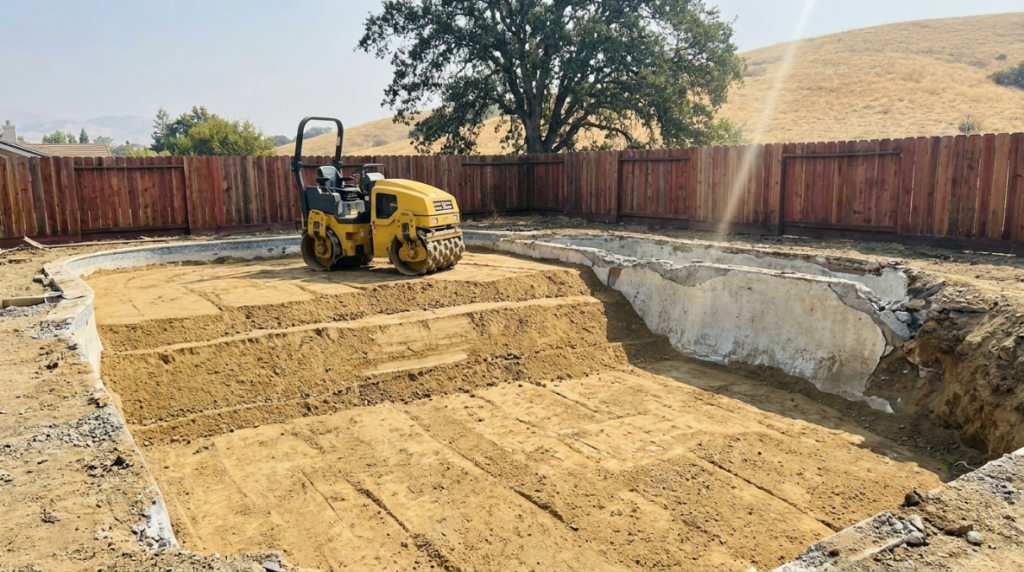
You are not really buying a report. You are buying the right to build on that spot later. A pool removal compaction report is the only piece of paper that tells a future building official, appraiser, or buyer that the ground where your pool used to be was engineered, tested, and signed off by someone licensed to make that call.
Three documents get confused constantly, and the terms do not help. A soils report studies your site before work starts and recommends how to build. A compaction report documents what actually happened during backfill and certifies the result. A Proctor test is the lab test that sets the density target the field crew has to hit.
This guide covers what a pool removal compaction report proves, what has to be inside it and who can sign it, and how Contra Costa County treats engineered fill differently from uncertified fill. If you are weighing options right now, our team can walk your property and tell you which path your lot qualifies for.
What a Pool Removal Compaction Report Actually Proves
A pool removal compaction report proves one specific thing: that the material placed in the pool cavity reached a measured percentage of its maximum achievable density, verified by field testing rather than by the crew’s judgment. It is a record of measurements, not an opinion about your yard.
The target is written as relative compaction. In Contra Costa County, backfill placed as engineered fill must reach a minimum of 90 percent relative compaction, or higher if the soils engineer requires it, tested in accordance with ASTM D1557. That 100 percent baseline comes from a lab test on your actual soil, so 90 percent means the fill in your yard hit 90 percent of what that same soil can reach under controlled conditions.
Here is the part homeowners miss. A pool removal compaction report is not proof that your pool is gone. It is proof that what replaced it behaves like ground instead of loose dirt in a hole, and only one of those claims lets you pour a foundation.
What Goes Inside the Report, and Who Signs It
A pool removal compaction report is prepared by a licensed civil or geotechnical engineer, and in Contra Costa County it goes to the Building Inspection Division for review and approval before any fill is accepted. Your demolition contractor does not write it and cannot sign it. That separation is the whole point, since the party doing the work is not the party certifying the work.
A complete report documents every round of field density testing run while the cavity was filled:
- Test location and depth, so each result maps to a specific lift of fill.
- Dry density and moisture content measured on site, usually with a nuclear density gauge or a sand cone test.
- The laboratory maximum dry density and optimum moisture content from the Proctor test.
- Relative compaction as a percentage, with a pass or fail result for each test.
- The engineer’s stamped certification, describing what the fill is suitable to support.
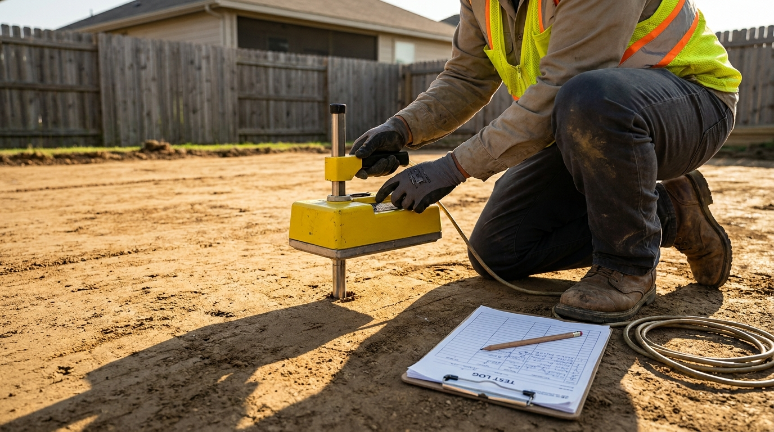
Moisture is half the job and almost nobody mentions it. Soil compacts best near its optimum moisture content, so fill that is too wet or too dry will not reach density no matter how many passes the roller makes. In the East Bay that turns into a scheduling question between November and March, when saturated clay in Concord and Pleasant Hill can stall a backfill for days.
Engineered Fill or Uncertified Fill: Two Very Different Paths
Contra Costa County splits pool backfill into two permit tracks, and you pick yours before the first bucket of soil goes in. Engineered fill is designated G (supervised, able to support a structure). Uncertified fill with the shell left in place is designated GN (unsupervised, not for supporting structures). Only the G track produces a pool removal compaction report. These rules apply in unincorporated areas, and cities like Concord, Walnut Creek, and Antioch run their own building departments, so confirm your jurisdiction first.
| Factor | Engineered fill (G permit) | Uncertified fill (GN permit) |
|---|---|---|
| Final compaction report | Required, stamped by a licensed civil or geotechnical engineer | Not required |
| Density requirement | Minimum 90 percent relative compaction per ASTM D1557, or as the soils engineer specifies | No certified density target |
| Pool shell | Removed on the soils engineer’s recommendation, or partially broken where the engineer directs | Left in place, top 24 inches of bond beam removed unless it sits above grade |
| Drainage holes | Location and extent set by the soils engineer | At least three holes, minimum 24 inches across, no more than 8 feet apart, one at the deepest point |
| Recorded on the parcel | No restriction note | A note stating the area is restricted and not suitable for building |
| Sloped lots | Available on any slope | Not allowed where ground slopes steeper than 10 percent |
| Future use of the area | Structures allowed once the report is approved | Landscaping only |
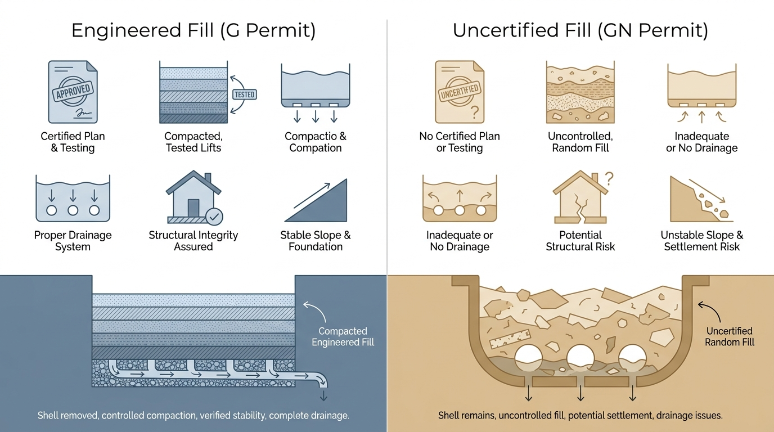
That slope rule catches people off guard. If your pool sits on ground steeper than 10 percent, common on lots stepping toward the Mount Diablo foothills in Clayton, Orinda, and Lafayette, the cheaper track is off the menu. You follow the engineered path whether you plan to build or not.
Where the Report Fits in the County Inspection Sequence
A pool removal compaction report is the last piece, but the testing behind it starts on day one of backfill. Contra Costa County calls for three grading inspections on a pool fill: a rough grade inspection of the excavation (#601), an in-progress inspection when fill reaches 48 inches from finished grade (#608), and a grading and drainage final (#620).
On engineered fill, the soils engineer inspects and approves the bottom of the cavity before any compacted fill goes in. Skip that step and nobody can certify what sits underneath, which leaves a hole in the middle of the pool removal compaction report. Sequence matters more than speed here.
One requirement matters if an addition is already on your drawings. County plans carry a note that the foundation for a new structure over the fill area cannot be poured until the final report is approved and inspected. Our guide on California pool removal permits explains how application, plan review, and inspection stages line up across jurisdictions.
The Part Nobody Warns You About: This Document Cannot Be Created Later
You cannot buy a pool removal compaction report after the fact. This is the most expensive misunderstanding in this corner of the industry, and it usually surfaces three or four years downstream, when someone applies for an ADU permit.
The reason is simple. Relative compaction is measured lift by lift as material goes in. Once the cavity is full, an engineer standing in your yard cannot certify layers buried under six feet of soil that nobody tested. No retroactive test produces the same document.
What you are left with instead:
- Re-excavation. Dig the fill out and replace it as engineered fill, with testing this time. In practice, a second demolition project.
- A new geotechnical investigation. An engineer evaluates the existing fill with borings and designs a foundation around it, such as deepened footings or a slab spanning the old cavity.
- Redesign around the footprint. Shift the structure off the fill area, which usually means a smaller building.
- Living with the parcel note. On a GN fill, the recorded restriction follows the property and shows up when you sell.
Ask any contractor bidding your job one question before signing: who is the licensed engineer performing the density testing, and is their report in this scope or billed separately? A vague answer tells you what you need to know. If you want that conversation with someone who answers directly, reach out and we will put the engineering scope in writing.
When a Pool Removal Compaction Report Is Worth It, and When It Is Not
A pool removal compaction report earns its place whenever there is a realistic chance of building over that ground. It makes sense when an ADU is on the table, when an addition or garage is planned near the footprint, when the lot slopes more than 10 percent, when you expect to sell within a few years, or when heavy hardscape is coming.
It is genuinely unnecessary when the area is becoming lawn or planting beds on a flat, self-contained lot with no construction ambitions, or when zoning already caps what could go there. Choosing uncertified fill is legitimate when it matches your plans. It stops being legitimate when nobody explains the recorded parcel note to you first.
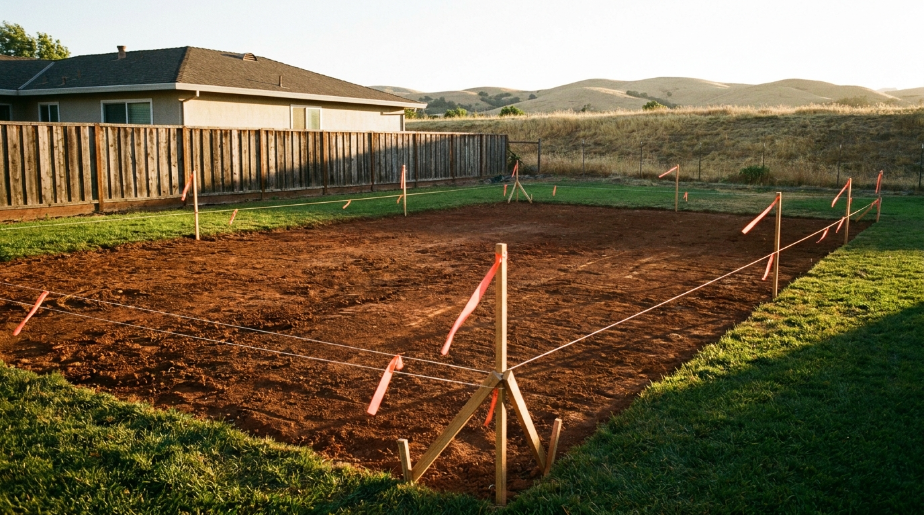
Here is a composite of a situation we see regularly, offered as an illustration rather than a specific customer. A homeowner off Ygnacio Valley Road in Walnut Creek wants a 1970s diving pool gone and assumes the yard is becoming lawn. Mid-walkthrough, she mentions her mother may move in within five years.
That sentence changes everything. Lawn does not require engineered fill. A future in-law unit does, and the pool occupies the only corner of the lot with setbacks for one. Going engineered from the start means one demolition, one round of testing, and a stamped pool removal compaction report in the permit record instead of a re-excavation five years later. Reviews our crews receive on Google and Yelp circle the same theme, which is that permits, inspections, and paperwork got handled rather than dropped on the homeowner.
Frequently Asked Questions About Compaction Reports
Is a compaction report the same thing as a soils report?
No. A soils report, or geotechnical investigation, is prepared before construction and recommends how the site should be prepared and what the foundation must account for. A compaction report is prepared during backfill and documents the density actually achieved through field testing. Pool projects that involve future construction often need both, at different stages.
Can I build an ADU over a filled pool without one?
Generally not on fill that was never certified, because building departments need documentation that the ground can carry the load. Without a compaction report from the original backfill, the options are re-excavating the fill or hiring a geotechnical engineer to investigate it and design a foundation around it. Both routes are slower than certifying the fill at the time of removal.
Does a compaction report expire?
The report does not expire, since it documents conditions at a fixed moment and becomes part of the permit record. What can change is the ground itself, particularly if drainage was never corrected and water has been running into the fill area for years. Building officials may still request a current geotechnical review if the fill is old.
Why do some filled pool areas settle years later?
Settlement usually traces back to fill placed too thick, compacted at the wrong moisture content, or dumped in without lift-by-lift testing. Uncertified fill has no record proving otherwise, which is why it is restricted to landscaping. Poor surface drainage makes it worse, since water moving through loose fill carries fine material downward and creates voids.
What makes engineered backfill more involved than uncertified fill?
The main factors are the volume of imported material, the number of lifts and density tests required, the engineer’s inspection time, and how hard it is to get compaction equipment into the yard. Access is the quiet one, since a narrow side yard in an older Concord neighborhood limits equipment size and slows every stage. Whether the shell comes out or is partially broken, set by the soils engineer, also shifts the scope.
What should I ask a contractor before signing?
Ask which permit track they are pulling and why, who the licensed engineer performing the testing is, and whether the report sits inside the quoted scope. Ask how many lifts they plan, at what thickness, and how they handle a failed density test. Ask to see the documentation package from a recent project with personal details removed.
Ready to Plan Your Pool Removal?
The decision that matters is not which contractor swings the excavator. It is whether the ground left behind is documented well enough to build on, and that gets decided before backfill starts. Review our coverage across Contra Costa County, or see how we work in our home city on our Concord pool demolition page. Our profile on Google and our listing on Yelp carry photos and feedback from recent Bay Area projects.
Tell us what you picture in that corner of the yard five years from now, and we will tell you what your pool removal compaction report needs to say to get you there. Call (925) 940-9978 or request a free on-site evaluation.