Pool Removal Rain Bay Area: What Happens to Backfill and Inspections When It Rains
What This Guide Covers
- Does rain stop a pool removal, or just slow it down?
- Which stages of the project are most sensitive to rain
- Why wet soil ruins backfill compaction and your final inspection
- The risk nobody warns you about: a drained shell sitting through a storm
- Runoff, your neighbor’s yard, and Bay Area wet season rules
- When pool removal rain Bay Area scheduling still makes sense in winter
- What a rain delay actually looks like, start to finish
- Is a partial fill-in safer than full removal during the rainy season?
- Can my pool be drained and left empty until the rain stops?
- Will a backfill placed in winter settle more over the years?
- Why does the ground over an old filled pool sink after heavy rain?
- Does rain make a pool removal more expensive?
- What should I ask a contractor about weather delays before signing?
- Planning around the weather instead of hoping for the best
Direct Answer: Rain rarely cancels a project, but pool removal rain Bay Area schedules usually pause at two points, open excavation and backfill compaction, because saturated soil cannot reach the density your final inspection depends on.
Rain in the Middle of Your Project
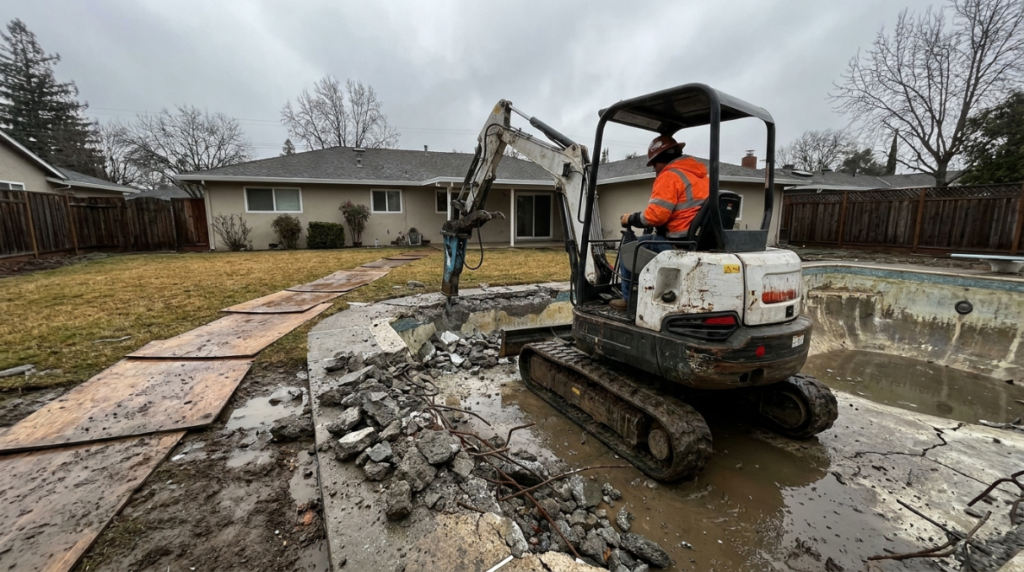
You sign in October, the crew is booked for the second week of December, and then an atmospheric river parks itself over Northern California for four days. That is a normal Bay Area winter, and the most common reason a backyard project stalls between demolition day and final grade.
Some of the confusion comes from the words in the bids. “Pool fill-in,” “partial removal,” “engineered fill,” and “rain day clause” all carry different weather risk, and a contract with defined weather language behaves nothing like one that leaves it open.
Pool removal rain Bay Area planning comes down to three things: which stages actually stop when it rains, what water does to backfill compaction and to the inspection that closes your permit, and how to decide whether to book now or wait for a dry stretch.
Does Rain Stop a Pool Removal, or Just Slow It Down?
Most rain reorders a pool removal rather than stopping it, which is why pool removal rain Bay Area delays get measured in days rather than cancelled dates. Breaking a gunite shell in a light drizzle is uncomfortable for the crew but technically fine. What stops is earthmoving, because the limiting factor is never the machine, it is the soil sitting under the machine.
Timing matters more here than in most of the country. The Bay Area gets nearly all of its rain between November and March, with December and January historically the wettest months and May through September running essentially dry. Storms arrive in multi-day trains rather than short afternoon showers, so one system can take a week off your calendar once you add the drying time behind it.
Which Stages of the Project Are Most Sensitive to Rain?
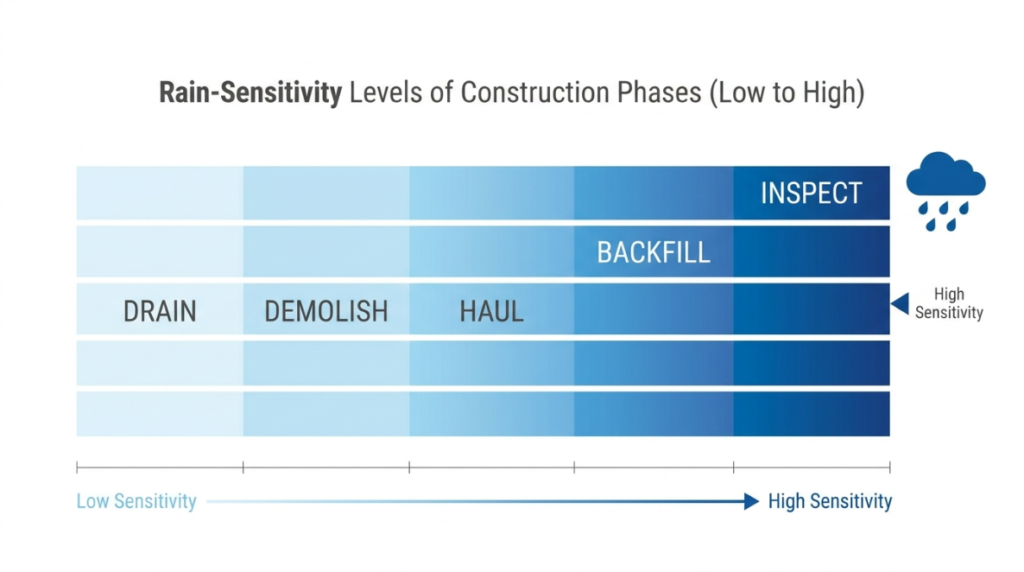
Rain sensitivity climbs steadily as the work moves from demolition toward finish grade. Five phases behave very differently once the ground is wet.
- Draining and utility disconnection. Low sensitivity. Lines can be capped in wet weather. Common mistake: discharging pool water without checking local rules on chlorine and where it may go.
- Shell demolition. Low to moderate. Concrete breaks fine in light rain. Common mistake: assuming the shell can then sit open for a week, which is where most weather damage starts.
- Debris haul-out and equipment access. High. Loaded machines on soaked turf leave ruts worse than the demolition itself. Common mistake: skipping plywood or track mats.
- Backfill and compaction. Highest. Fill placed too wet will not hit target density no matter how many passes the compactor makes. Common mistake: pushing ahead so the crew can finish that week.
- Final grading and inspection. High. Density testing and the inspector both need a workable surface. Common mistake: booking the inspection before the site dries, which buys a second trip and a longer open permit.
| Project stage | Rain sensitivity | What a crew does instead |
|---|---|---|
| Drain and disconnect utilities | Low | Proceeds, with controlled discharge |
| Break and remove the shell | Low to moderate | Proceeds in light rain, perforates the floor early |
| Haul debris and move equipment | High | Protects access paths, or pauses to protect the yard |
| Place and compact backfill | Highest | Stops, covers the site, waits for moisture to drop |
| Final grade and inspection | High | Reschedules the inspection window |
Why Wet Soil Ruins Backfill Compaction and Your Final Inspection
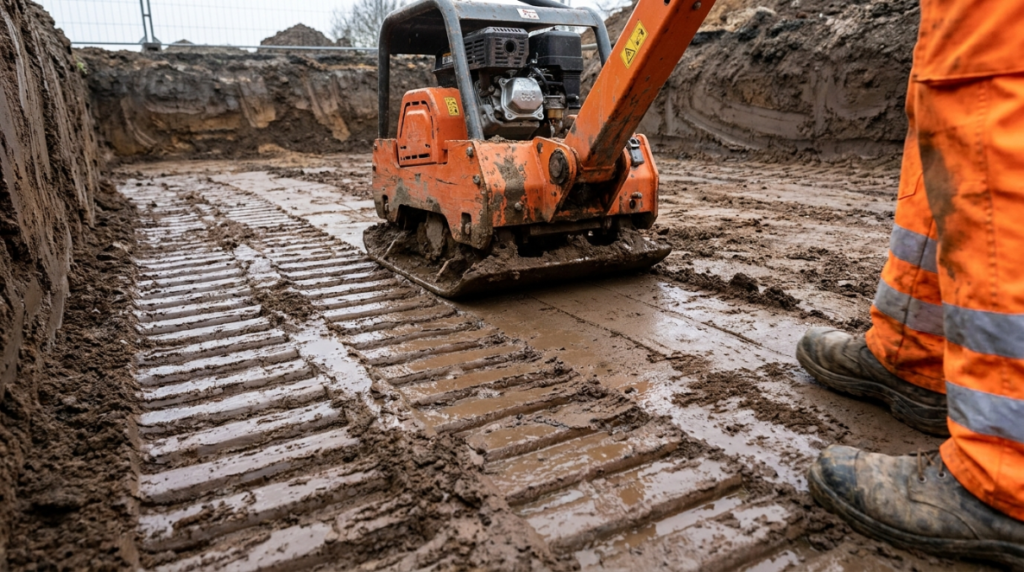
Soil reaches maximum density at one specific moisture level, and rain pushes it past that point. A lab Proctor test produces the two numbers your project depends on: the maximum dry density of that soil and the optimum moisture content needed to reach it. Standard Proctor testing puts optimum moisture around 10 to 12 percent for granular soils like sand and gravel, and roughly 15 to 20 percent for silty and clay soils.
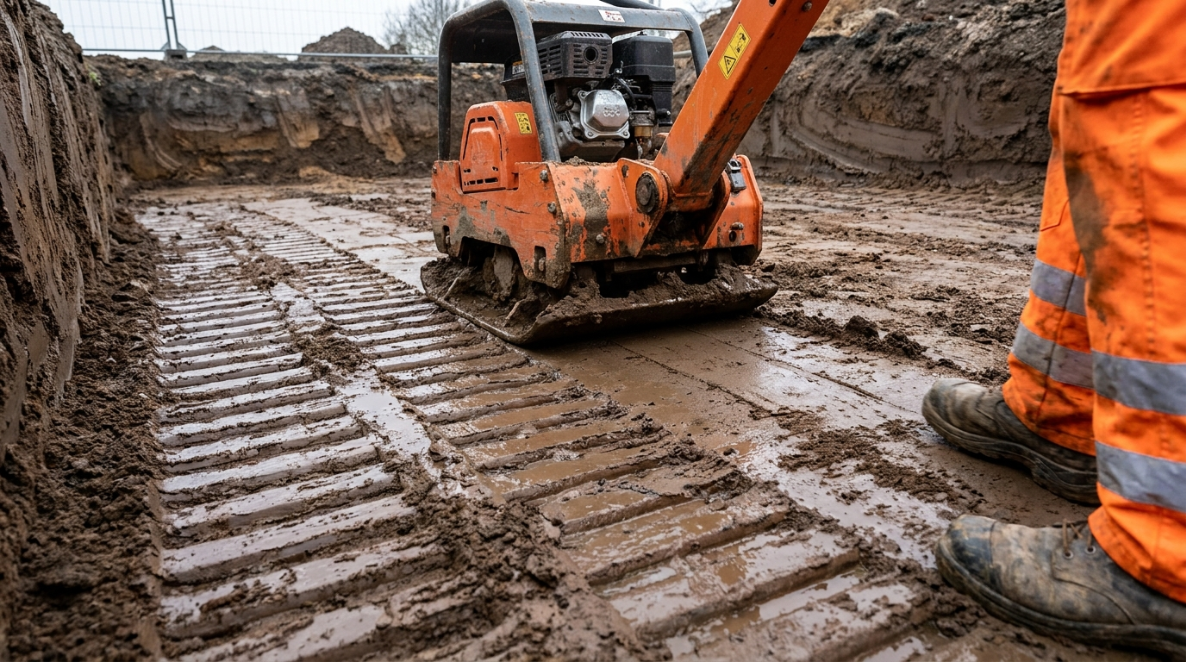
Past that optimum, water stops helping. Instead of letting particles slide into a tighter arrangement, it fills the voids and will not compress, so density drops. Crews call the visible version “pumping,” where ground flexes and springs back under the roller instead of tightening up.
That is why pool removal rain Bay Area projects stall at this exact stage. Much of Contra Costa and Alameda County sits on highly expansive clay, which is the worst material for this problem because it holds water and gives it up slowly. A yard in Concord or Pleasant Hill on Pleasanton or Los Osos series clay can stay too wet to compact for days after the last cell passes, while a sandier lot in the same county is back to work far sooner.
Fill goes in as lifts, typically in the 6 to 12 inch range, each compacted before the next. Relative compaction is reported as a percentage of the lab maximum, commonly specified between 90 and 95 percent for residential backfill, with your permit conditions and any geotechnical report setting the actual number. When a lift runs slightly over optimum, our crews can spread and aerate it to dry. When it is well past optimum, no technique beats waiting.
The Risk Nobody Warns You About: A Drained Shell Sitting Through a Storm
The riskiest moment in the whole project is the gap between draining the pool and demolishing it. A full pool is held down by the weight of its own water. Drain it, and that counterweight disappears while groundwater keeps pushing up from underneath.
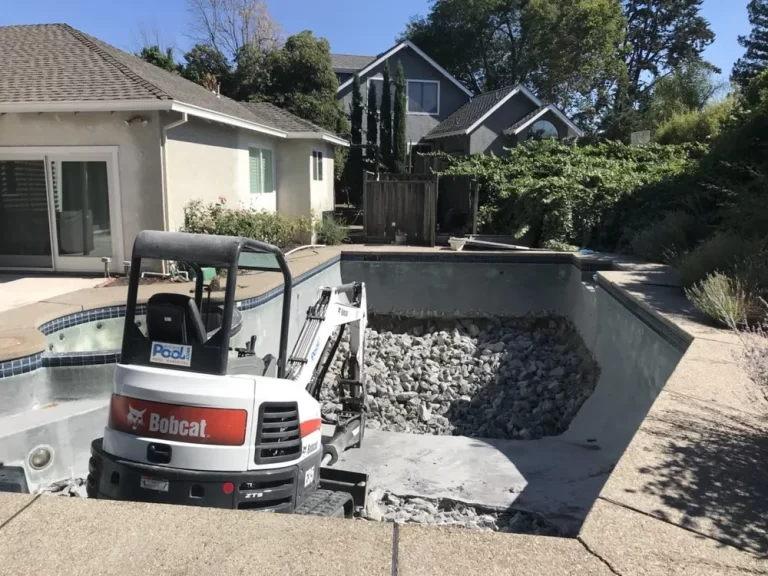
After heavy rain the water table rises, and that upward pressure can exceed the weight of the empty shell. The result is a floated or “popped” pool: the structure lifts, cracks, and shifts out of position. It is uncommon, but far more likely on clay soils right after a big storm, which is exactly the Bay Area winter profile. A floated shell also slows demolition, since nothing sits where the crew planned to break it. The simpler risk is a half-drained shell filling with runoff, which becomes a deep pit of soft mud with no visible edge.
Sensible mitigation for wet weather work looks like this:
- Perforate the pool floor the same day the water comes out, so groundwater passes through instead of pushing up
- Keep the drained-to-demolished window short, ideally same day or next day
- Pull hydrostatic relief plugs where the pool has them, rather than assuming they still function after years in place
- Discharge drained water downhill and well away from the shell, never right beside it
- Fence or cover the open excavation before the crew leaves for the weekend
- Check the forecast before draining, not after
One question is worth asking every bidder: if a storm hits after my pool is drained but before demolition starts, what happens, and who carries that risk? Anyone who has run winter jobs will have an immediate answer.
Runoff, Your Neighbor’s Yard, and Bay Area Wet Season Rules
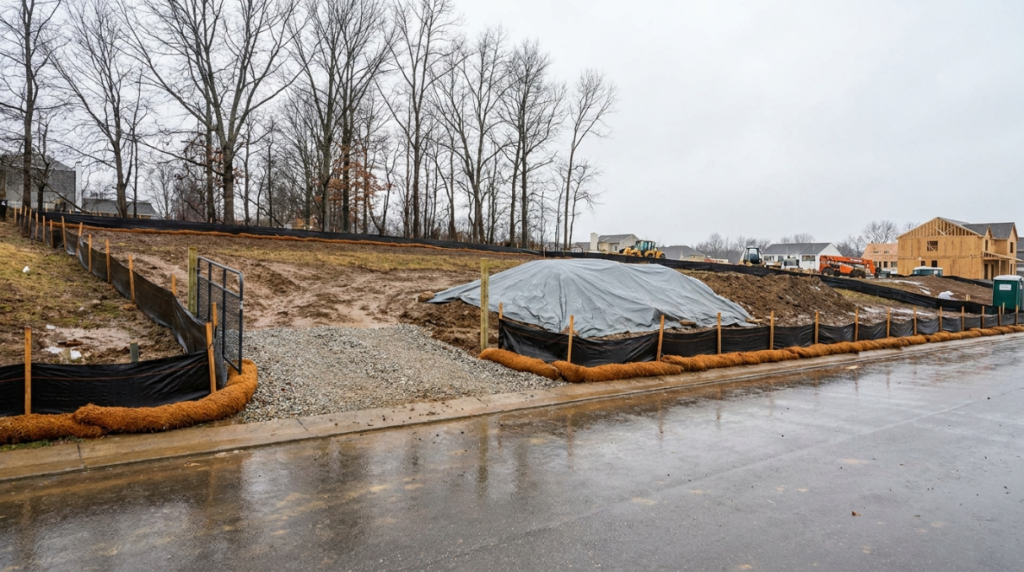
Rain turns your excavation spoil into someone else’s problem faster than most homeowners expect. Loose soil piled beside an open pit moves downhill in a storm, and on the sloped lots common in the Oakland and Berkeley hills that path often runs into a neighbor’s yard or a street storm drain.
Local rules take this seriously. Many California jurisdictions define a rainy season running roughly October 1 through April 30, require erosion and sediment controls to be functional on disturbed ground during that window, and some restrict grading work in those months. A site without adequate controls can draw a stop work order, a far longer delay than the rain. In practice a well run winter job uses fiber rolls or silt fence on the downhill side, covered stockpiles, a stabilized entry point so tires do not track mud into the street, and daily sweeping while hauling is active.
When Pool Removal Rain Bay Area Scheduling Still Makes Sense in Winter
Winter scheduling works well in specific situations and poorly in others. Booking in the wet season tends to pay off when:
- Your lot drains well, more common in the valley areas around Danville and San Ramon than in low ground near the bay
- Access is wide and paved, so equipment never crosses soaked lawn, like a Livermore property with a full-width side gate
- You want the area graded and seeded early enough to have grass established by summer, and your start date can move with the forecast
It is a harder call when:
- You are on a hillside lot where runoff control is the whole project, not a detail
- You are building an ADU or addition over the fill and need certified compaction results, since that testing is the part rain most reliably blocks
- Your property sits on bay mud or soft lowland soil, common near the shoreline in Alameda, where drainage is slow
- Your only equipment path crosses a lawn you care about
If several of those apply, pushing the pool removal rain Bay Area risk into late spring is usually the better trade. Our overview of the counties and cities we serve explains which parts of the East Bay we schedule around most carefully in winter, and you can review it on our Bay Area service areas page.
What a Rain Delay Actually Looks Like, Start to Finish
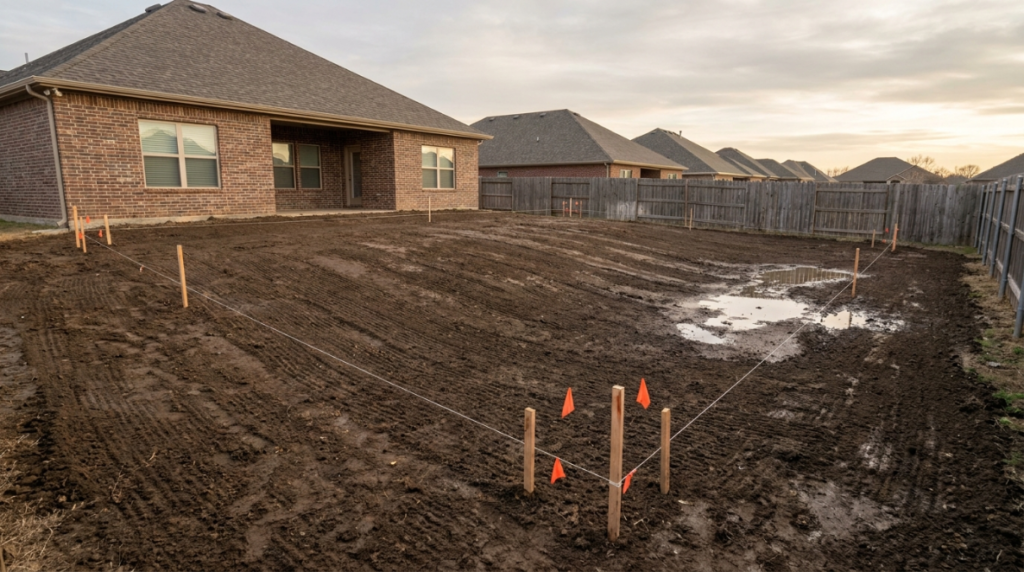
Here is a composite of how these projects unfold, drawn from the pattern we see rather than one named customer. A Concord homeowner with a 16 by 32 gunite pool books an early February start for a full removal, planning a lawn and patio.
The crew drains on Monday, perforates the floor that afternoon, and breaks the shell Tuesday and Wednesday. A storm arrives Thursday. Demolition is done and debris hauled, but the open cavity now holds standing water, so backfill does not start. The site sits protected through the following week while the clay dries. Compaction runs over three days once moisture drops back into range, final grade follows, and the inspection lands about ten days later than planned. Nothing failed. The schedule absorbed a storm, which is what a winter contract is for.
Two themes come up repeatedly in customer feedback, and both matter more in February than in July: crews that protect access routes instead of tearing up a yard, and clear communication when a date moves. You can read those reviews on our Yelp business page, or find project photos through our Google Business Profile in Concord.
Pool Removal Rain Bay Area: Questions Homeowners Ask
Is a partial fill-in safer than full removal during the rainy season?
A partial fill-in is not inherently safer in wet weather. It leaves the lower shell in place with the floor perforated, so less material moves through mud, but the backfill above it still has to be compacted at the right moisture. The problem shrinks, it does not go away.
Can my pool be drained and left empty until the rain stops?
Leaving a drained shell open through a storm is the riskiest thing you can do. Without the weight of water inside, rising groundwater can push the empty structure upward, and an open pit refilling with runoff is a hazard meanwhile. Drain only when the crew is ready to demolish.
Will a backfill placed in winter settle more over the years?
Fill placed in winter settles no differently than summer fill, provided it was compacted at the right moisture and tested. Settlement comes from fill placed too wet, lifts that were too thick, or density never verified. Ask for compaction results in your closeout documents.
Why does the ground over an old filled pool sink after heavy rain?
Sinking over an old pool traces back to under-compacted fill, not to the rain itself. Water only reveals it, seeping into loose fill and washing fines into voids. On the expansive clay common across Contra Costa and Alameda County, seasonal wetting and drying makes the movement more visible each winter.
Does rain make a pool removal more expensive?
Rain shows up through specific factors, not a flat weather surcharge. The main ones are dewatering, ground protection for equipment access, wet season erosion controls, extra days of site protection while soil dries, and repeat inspection trips. Ask each bidder how their proposal handles those five.
What should I ask a contractor about weather delays before signing?
Ask how many days can pass between draining and demolition, what happens if a storm hits in that window, how compaction moisture is verified, and what erosion controls are included from October through April. Vague answers on any of those are a reason to keep looking.
Planning Around the Weather Instead of Hoping for the Best
Weather is not really the variable in a winter project. Soil moisture is, and crews who work through Bay Area winters plan the sequence around it instead of fighting it. Demolition is rarely the hard part. Getting fill to the right density, then getting it inspected, is where the calendar moves.
If you are weighing a pool removal rain Bay Area timeline for the coming season, the most useful step is to talk through your specific lot, its soil, its slope, and its access before picking a date. Our page on how we work explains how we sequence demolition, hauling, backfill, and final grade, and you can read it on our about our pool removal team page. When you are ready to put dates on the calendar, reach out for a site visit and we will walk the yard with you and give you an honest read on whether to start now or wait for the dry season.