Pool Removal Rainy Season Guide: Planning Around the 2026-27 El Niño Winter in the Bay Area
Table of Contents
- What the 2026-27 El Niño winter means for the Bay Area
- Pool removal rainy season: can you do it in winter?
- The problem nobody mentions: rain changes the soil, not just the calendar
- How each stage of a winter pool removal changes
- Book now or wait for the dry window? A side-by-side look
- When winter pool removal makes sense, and when to wait
- A hypothetical example: planning around El Niño in Walnut Creek
- What you can do this month to get ready
- Frequently Asked Questions
- Is a pool fill-in or a full removal better in a wet winter?
- Should I remove my pool before the rainy season if I plan to build an ADU there?
- Does a filled pool area need attention after its first winter?
- Why does a backyard sink after a pool is filled in?
- Does rain affect what a pool removal costs?
- What should I ask a pool removal contractor before booking in winter?
- Final thoughts
Direct Answer: Pool removal rainy season projects in the Bay Area are still doable this El Niño winter, but wet soil, compaction limits, and inspection scheduling can stretch the timeline, so lock in permits, access, and decisions before storms arrive.
If you have been putting off getting rid of an old pool, this fall probably has you wondering whether you missed your chance. You keep hearing about a “Godzilla El Niño,” your neighbor says nobody can dig once it starts raining, and online you see “pool fill-in,” “pool demolition,” and “pool abandonment” used as if they were the same thing. They are not, and the difference matters more in winter than in July.
We remove pools across Contra Costa and Alameda County every season, including the wet one. The honest answer is that winter work is possible, but it runs on different rules. A dry August yard forgives a lot. A saturated January yard forgives almost nothing.
This guide covers three things: what the current El Niño outlook really tells you (and what it does not), how rain changes each stage of a pool removal, and how to decide whether to book now or wait for drier months. If you would rather talk it through with a person, you can reach our Concord team here and we will look at your yard with you.
What does the 2026-27 El Niño winter actually mean for the Bay Area?
The 2026-27 El Niño raises the odds of a wetter Bay Area winter, but it does not guarantee one. NOAA’s Climate Prediction Center has issued an El Niño Advisory for this winter, and its October update expects a strong to very strong event to last into early 2027.
That sounds dramatic, and it is a big event by historical standards. Still, the Climate Prediction Center itself says a strong El Niño makes typical impacts more likely, not certain. Bay Area forecasters have said the same thing for years: El Niño tilts the odds toward a wetter Northern California winter, and each event behaves a little differently. Local weather still comes down to individual storms.
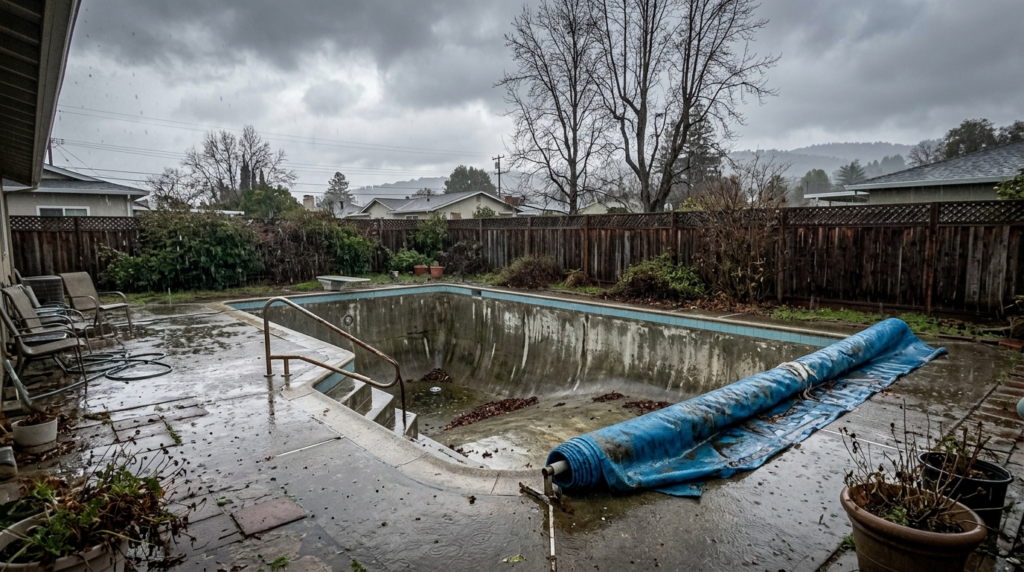
For planning, the useful part is the calendar, not the headline. Several Bay Area cities define the local rainy season as roughly mid-October through mid-April; Palo Alto, for example, uses that window in its storm-readiness guidance. Early fall often stays dry, and the steadier rain tends to arrive later in the season. That means your pool removal rainy season plan has two realistic phases: a shrinking dry window right now, and a wet stretch where work happens between storms.
What we would not do is treat El Niño as a reason to panic or a promise of floods. Treat it as a reason to plan with more buffer than usual.
Pool removal rainy season: can you do it in winter?
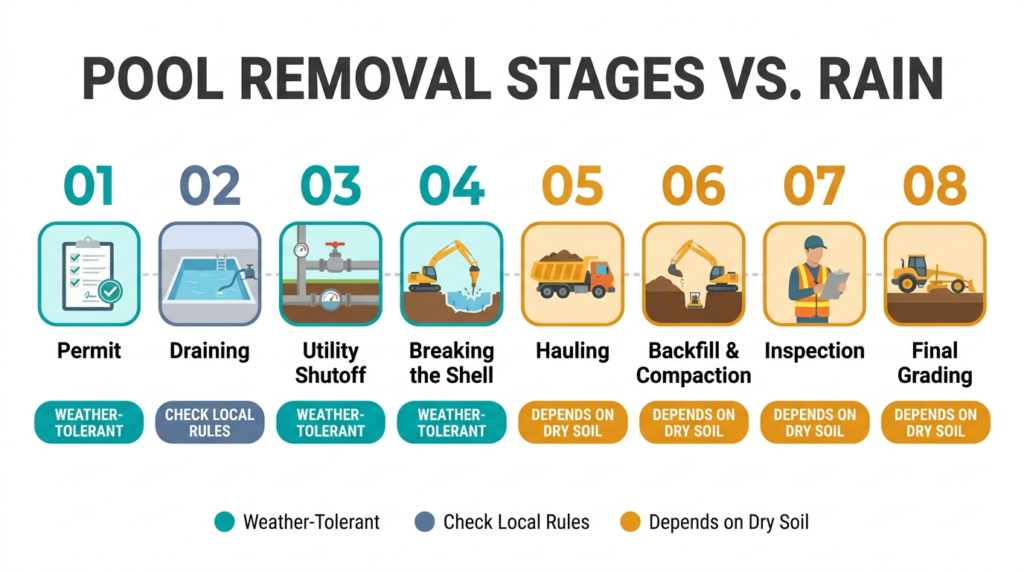
Yes, you can remove a pool during the rainy season, but the schedule follows the soil and the inspector, not just your calendar. Demolition itself is fairly weather-tolerant. Backfill, compaction, and final grading are where wet weather slows things down.
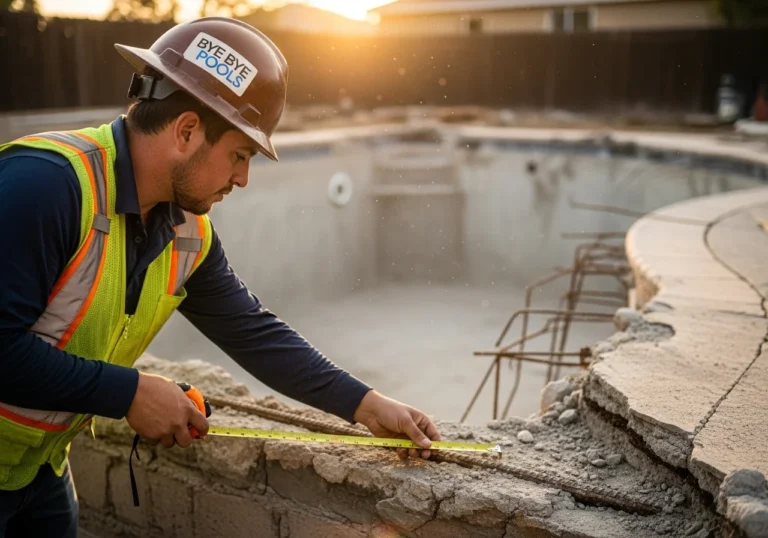
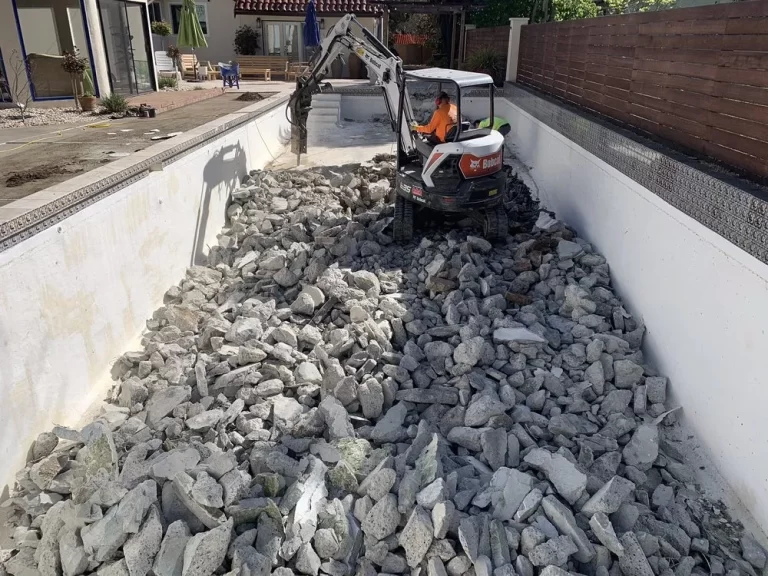
A typical pool removal moves through permits, draining, utility shutoff, breaking the shell, hauling debris, placing and compacting fill, inspection, and grading. In summer, those steps run back to back. During a pool removal rainy season job, they run in bursts. Our crews may break concrete on a cloudy Tuesday, pause through a storm, and come back to place fill once the material and the hole are workable again.
Two things stay the same in any season. First, the permit comes before the jackhammer. Second, the work is only finished when the fill is placed correctly and the city signs off. Rain does not change those rules. It only changes how long it takes to meet them.
Not sure which path fits your yard? Send us a few photos and your address, and we will tell you honestly whether your project is a good winter candidate.
The problem nobody mentions: rain changes the soil, not just the calendar
The biggest rainy season risk in pool removal is not a muddy yard; it is fill soil that gets too wet to compact properly. Most people picture rain as a “day off” problem. The real issue is what water does to the dirt going into the hole.
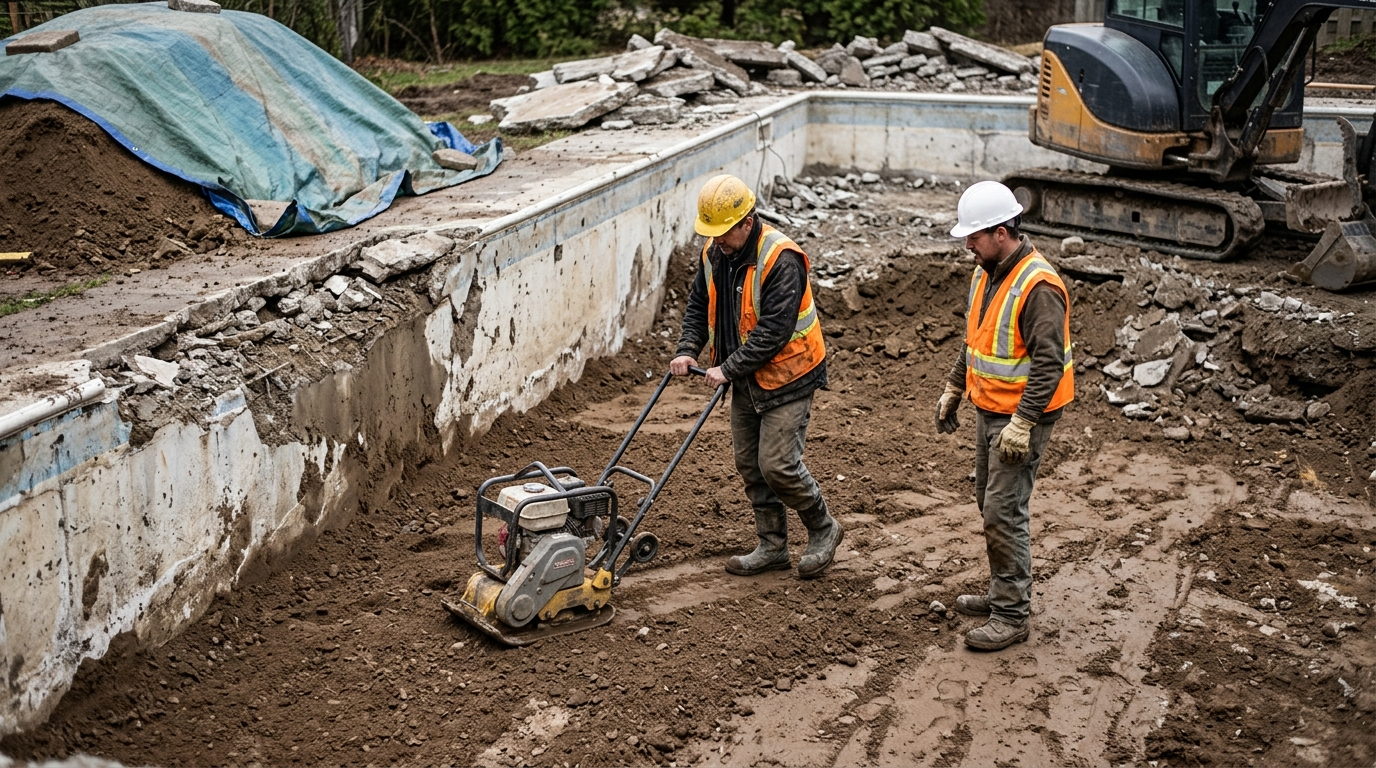
Compaction works when soil has the right amount of moisture. Too dry and it will not bind. Too wet and it turns to paste that pumps and shifts under the compactor instead of tightening up. Livermore’s published pool removal guidance says it plainly: backfill soil that is too wet or too dry cannot be properly compacted. The same guidance warns that loose, uncompacted fill can settle and leave a depression that changes how stormwater moves across your yard.
Bay Area clay adds a second wrinkle. Highly expansive clay swells when it is wet and shrinks when it dries out, which is why many cities discourage using it as pool backfill. A winter of heavy rain followed by a hot summer is exactly the cycle that exposes a poorly chosen fill.
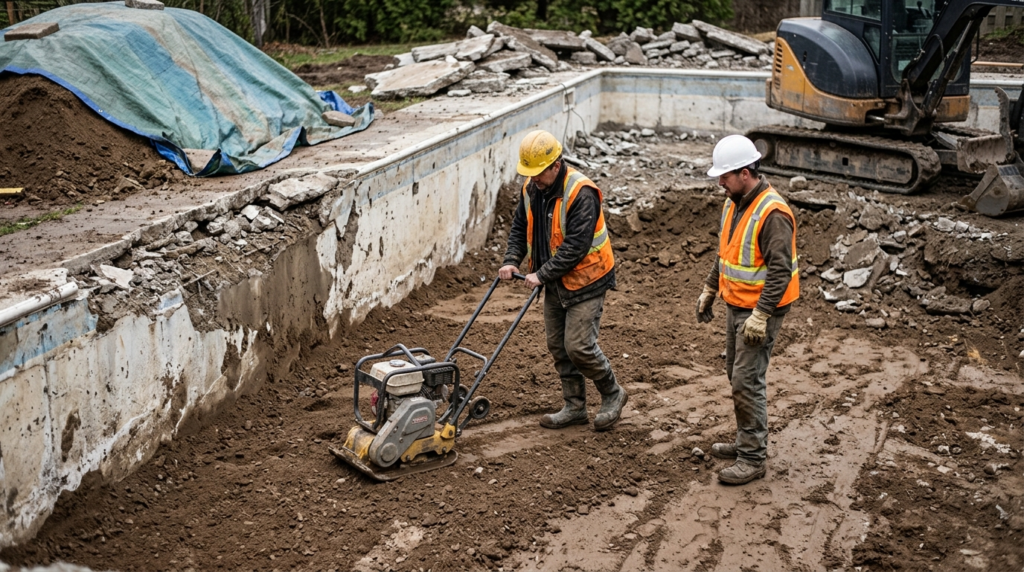
Here is how a careful contractor handles pool removal in the rainy season:
- Stockpile management: fill material is covered or delivered close to the day it is placed, so it does not sit soaking up rain.
- Drainage through the old shell: the pool bottom is broken so rainwater can drain into the ground instead of pooling inside the fill. Some cities spell out how this should be done.
- Working between storms: fill goes in only when the material is workable, even if that means waiting a few days.
- Erosion control on open ground: exposed soil near fences, slopes, and storm drains gets protected so it does not wash into the street or a neighbor’s yard.
- Inspection timing: the crew coordinates with the inspector so the fill is checked before the next storm, not after.
One practical question to ask any contractor before you sign: “If it rains in the middle of backfill, what exactly do you do with the fill that is already in the hole?” A clear, specific answer is a good sign. A shrug is not.
How each stage of a winter pool removal changes
Each stage of a pool removal reacts to rain differently, so it helps to know which steps you can push forward now and which ones depend on the weather. Here is the quick version we walk homeowners through.
- Permit and plan review: weather-proof. This is the best thing to start immediately. Common mistake: waiting for the first dry week to apply, then losing that week to plan review.
- Draining the pool: possible in most weather, but how pool water must be handled varies by city and county. Common mistake: draining to the street without checking local rules. Ask your city or county how pool water must be handled.
- Utility shutoff: gas and electrical lines to the pool equipment have to be safely terminated. Rain rarely blocks this step. Common mistake: leaving it until the crew is already on site.
- Breaking the shell: fairly weather-tolerant, since concrete does not care about drizzle. Common mistake: assuming a fast demo day means a fast project.
- Hauling and equipment access: wet lawns and soft side yards can rut under loaded equipment. Common mistake: not planning protection for turf, pavers, or irrigation along the access path.
- Backfill and compaction: the most weather-sensitive step by far. Common mistake: dumping fill fast to “beat the storm,” which is how settlement problems start.
- Inspection: depends on the inspector’s calendar and on the fill being ready to check. Common mistake: scheduling it too tight to the forecast.
- Final grading: needs workable soil and a slope that sends water away from the house. Common mistake: grading flat, which invites ponding on the old pool footprint.
Our existing guide on the pool removal timeline from first call to final inspection breaks down each of these stages in more detail, including what typically happens between them.
Book now or wait for the dry window? A side-by-side look
Booking your pool removal now usually wins on readiness, while waiting for spring usually wins on predictable ground conditions. Neither choice is wrong. The table below compares them on time and effort only.
| Factor | Book now (fall into winter) | Wait for the dry window (late spring) |
|---|---|---|
| Permit progress | Paperwork moves while the weather does not matter | Permit review may overlap with peak demand |
| Soil conditions | Work happens between storms; some waiting days are likely | Soil is easier to bring to the right moisture |
| Schedule predictability | Start date is firm; finish date depends on rain | Start and finish dates are easier to predict |
| Yard disruption | Open ground may sit longer between steps | Steps run closer together |
| Ready for spring projects | Yard can be ready for landscaping or an ADU by spring | New projects start later in the year |
| Best fit | Flat lots, good access, flexible deadlines | Hillsides, tight access, tight deadlines |
Booking now locks your place in line. Waiting locks in easier soil. That trade-off is the whole decision for most yards.
If you are leaning toward a fall or early-season start, our article on whether fall is the best time to remove a pool in California explains why the weeks before steady rain are so popular.
When winter pool removal makes sense, and when to wait
Winter pool removal makes the most sense when your yard drains well, equipment can get in easily, and your deadline has some give. Here are the scenarios where we usually tell homeowners to go ahead with a pool removal rainy season start.
- A flat lot with a wide side yard, like many single-story homes in Concord or Pleasant Hill, where equipment can reach the pool without crossing a long stretch of lawn.
- A pool you want gone before spring planting, for example a family in Danville planning drought-tolerant landscaping that needs a finished, graded surface by April.
- A pool that is already a safety worry, such as a cracked, half-empty pool behind a rental in Antioch where nobody wants standing water all winter.
- A project where the permit is the slow part, since starting paperwork now keeps you moving even if the dirt work waits for a dry spell.
And here is when waiting for the dry window is often the smarter call:
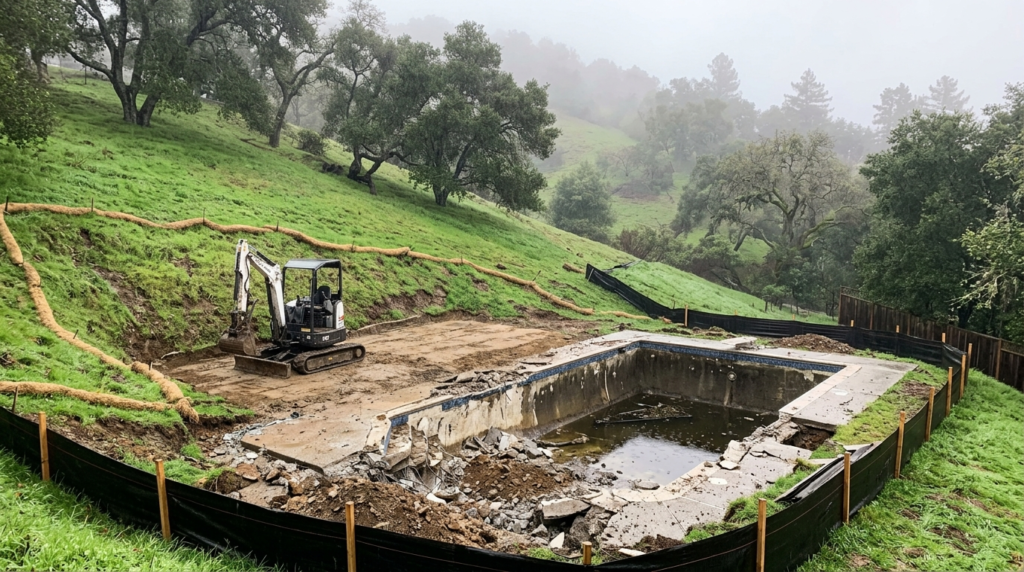
- Hillside pools, common in Lafayette, Orinda, and the Oakland hills, where open ground on a slope raises erosion concerns during long storms.
- Tight access, such as narrow side yards in Berkeley or Albany where every pass with equipment crosses soft ground.
- Projects that depend on an engineer’s report, for example clearing space for an ADU in Pleasanton or Fremont, where fill must be placed and tested to the engineer’s specifications and a rained-out test day pushes everything back.
- A hard deadline, like a home sale closing on a fixed date, where a few lost weeks would cause real trouble.
Some jurisdictions add rules for grading and erosion control during wet months, so check yours, or ask your contractor to check as part of the permit process.
A hypothetical example: planning around El Niño in Walnut Creek
The example below is a composite, not a specific customer, but it reflects how a well-planned winter pool removal tends to unfold.
Picture a homeowner in Walnut Creek with a 1970s concrete pool nobody has swum in for years. They call in October, hearing that El Niño could make the winter wet. Instead of rushing, they split the project. The permit application, the utility shutoff, and the decision between full and partial removal all happen in the dry weeks. Draining and demolition follow quickly.
Then the storms arrive. The broken shell and the drainage openings are already in place, so rain soaks into the ground instead of filling the hole. The crew waits out two wet stretches, places fill only when it is workable, and schedules inspection right after a dry spell. The finish date slides by a couple of weeks. The yard is graded and ready for new landscaping before spring.
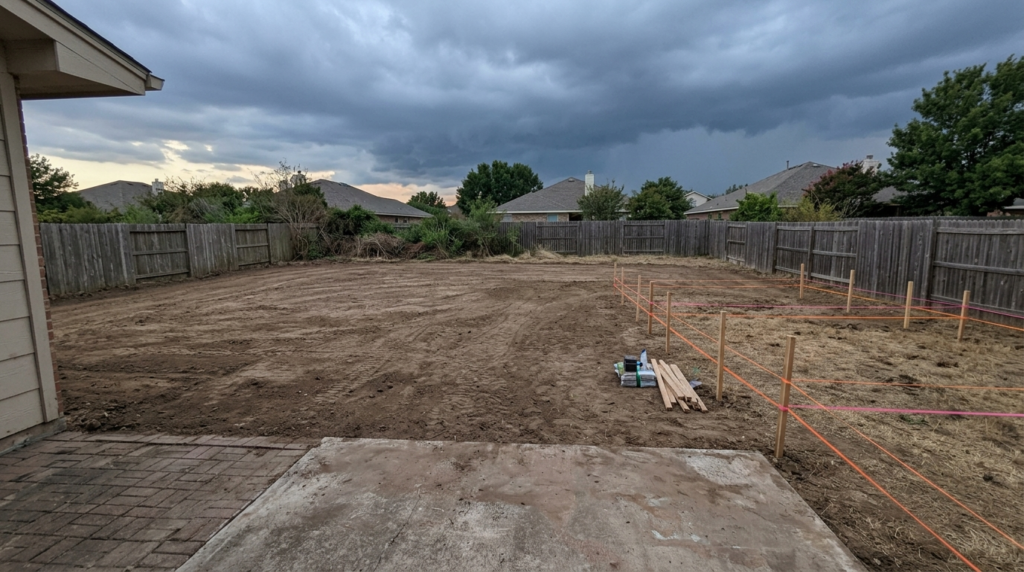
The takeaway is simple: the delay came from weather, not from mistakes. That is what good pool removal rainy season planning looks like. You cannot control the storms, but you can make sure they only cost you time.
What you can do this month to get ready
The best thing you can do this month is finish every decision that does not depend on weather. That way, your pool removal rainy season project can move the moment the ground cooperates.
- Decide full or partial removal and whether you might build on that spot later, since that choice affects how the fill must be placed and documented.
- Start the permit, or ask your contractor to handle it. Our frequently asked questions page covers common permit and process questions.
- Map the access path from the street to the pool and note gates, sprinklers, and anything that needs protection.
- Ask your city how pool water must be handled before anyone drains it.
- Clear the deadline question: if you need the yard finished by a fixed date, say so up front so the plan includes weather buffer.
If you want to see how past customers describe working with our crews, our Bye Bye Pool reviews on Yelp are a good place to start. We also post project photos, including winter jobs, on our Facebook page.
Frequently Asked Questions
Is a pool fill-in or a full removal better in a wet winter?
A pool fill-in, sometimes called partial removal, leaves part of the shell in the ground and is often faster, while full removal takes everything out and usually involves more hauling and more fill. In a wet winter, the faster job means fewer days with open ground. A full removal, though, gives you more options to build on the area later. The right choice depends on your plans for the space, not only on the weather.
Should I remove my pool before the rainy season if I plan to build an ADU there?
If you plan to build an ADU or any structure over the old pool, the fill usually has to be placed and documented to an engineer’s specifications. Wet weather can delay testing and approval of that fill. For an ADU site, starting permits and engineering now makes sense, but the fill work may go more smoothly in a dry window. Ask your city what it requires before you choose a date.
Does a filled pool area need attention after its first winter?
A filled pool area should be checked after its first wet season, because heavy rain is the first real test of the fill. Look for low spots, standing water, or cracks in nearby paving. Minor settling on the surface can often be topped off and regraded. Bigger dips are worth a call to your contractor, especially if the work is recent.
Why does a backyard sink after a pool is filled in?
A backyard usually sinks after a pool is filled in because the fill was not compacted properly, the wrong material was used, or water had no way to drain out of the old shell. Fill that is too wet during placement is a common cause. Large chunks of debris can also leave hidden voids that collapse later. Good compaction, suitable fill, and drainage openings in the pool bottom prevent most of these problems.
Does rain affect what a pool removal costs?
Rain can affect a pool removal project through factors like extra days on site, added protection for access paths, erosion control on exposed soil, and the type of fill required. Site access, pool size, and full versus partial removal usually matter more. The best way to understand your own project is an on-site look. A contractor can then explain which factors apply to your yard.
What should I ask a pool removal contractor before booking in winter?
Before booking a winter pool removal, ask who handles the permit and inspections, how the fill is protected from rain, and what happens if a storm hits mid-backfill. Ask how they protect your lawn and access path from equipment. Ask how they will handle the pool water under your local rules. Clear, specific answers to these questions tell you more than any promise about speed.
Final thoughts: plan the paperwork now, let the weather set the pace
This El Niño winter does not have to put your project on hold. Most of the work that slows people down, like permits, decisions, utility shutoff, and access planning, has nothing to do with rain. The parts that do depend on weather just need patience and a crew that knows when to wait.
If you are weighing a pool removal rainy season start, we are happy to look at your yard and give you a straight answer about timing. Call us at (925) 940-9978, visit us at 4918 Clayton Rd, Concord, CA 94521, or request your on-site consultation online.